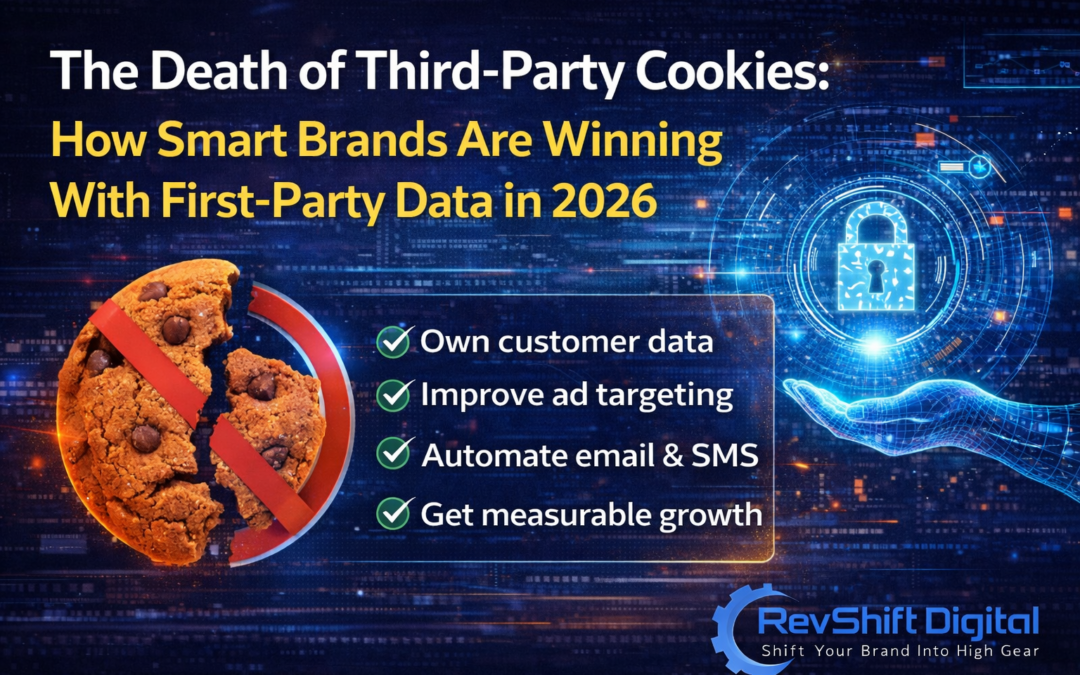
For years, digital advertising relied heavily on third-party cookies.
They tracked users across websites.
They powered retargeting ads.
They helped platforms build detailed audience profiles.
But in 2026, that era is effectively over.
Privacy regulations, browser restrictions, and consumer demand for transparency have reshaped digital marketing permanently.
The brands that adapt are thriving.
The ones that don’t are watching performance decline.
What Happened to Third-Party Cookies?
Major browsers like Safari and Firefox blocked them years ago.
Chrome followed.
Now, tracking users across the web the way marketers once did is no longer reliable—or compliant in many regions.
This shift means:
- Retargeting audiences are smaller
- Attribution is harder
- Ad platforms have less data
- Performance can feel inconsistent
If your ads aren’t performing like they used to, this is likely part of the reason.
Why First-Party Data Is the New Growth Engine
First-party data is information collected directly from your audience.
That includes:
- Email subscribers
- CRM contacts
- Website form submissions
- Purchase history
- Survey responses
- SMS opt-ins
- Customer behavior inside your own platform
Unlike third-party data, you own it.
And in 2026, ownership equals power.
The Competitive Advantage of First-Party Data
Brands that build strong first-party data systems gain:
Better ad targeting
Custom audiences built from your own list outperform cold targeting.
More accurate attribution
When you control the data, you control the tracking.
Higher customer lifetime value
Email and SMS flows increase repeat purchases and retention.
Stronger personalization
Messaging becomes relevant instead of generic.
First-party data isn’t just a workaround.
It’s a smarter long-term strategy.
Why Most Businesses Are Behind
Many businesses still rely too heavily on:
- Boosted posts
- Cold ad targeting
- Platform-generated audiences
- Basic email blasts
- No structured CRM
Without a real data strategy, growth becomes unpredictable.
And unpredictable growth is expensive.
How to Build a First-Party Data Strategy
Here’s what leading brands are doing right now.
1. Upgrade Your Lead Capture
If your website only has a “Contact Us” form, you’re underutilizing traffic.
Add:
- Lead magnets
- Free audits
- Resource downloads
- Email opt-ins
- SMS signups
- Webinar registrations
Give people a reason to raise their hand.
2. Implement a Real CRM System
Your CRM should:
- Track lead stages
- Automate follow-ups
- Segment contacts
- Store behavior data
- Integrate with ads and email
Without a CRM, your data stays fragmented.
With one, your marketing becomes strategic.
3. Connect Ads to Your Own Audiences
Instead of relying purely on platform targeting:
- Upload customer lists
- Build lookalike audiences
- Retarget site visitors
- Segment by engagement level
Your own data will outperform cold targeting almost every time.
4. Create Automated Email + SMS Flows
Stop sending one-off campaigns.
Instead, build:
- Welcome sequences
- Nurture flows
- Abandoned cart reminders
- Re-engagement campaigns
- Post-purchase upsells
Automation increases revenue without increasing ad spend.
5. Prioritize Data Accuracy
Clean tracking matters.
Ensure:
- GA4 is properly configured
- Conversion tracking is accurate
- CRM tags are consistent
- Forms connect to automation
- Attribution models are aligned
Bad data leads to bad decisions.
The Future of Marketing Belongs to Owned Audiences
Ad platforms will continue changing.
Algorithms will evolve.
Privacy laws will tighten.
But one thing will remain stable:
The brands that own their audience win.
First-party data gives you control.
Control gives you predictability.
Predictability gives you growth.
What This Means for Your Business in 2026
If you want stable growth this year:
- Stop depending solely on cold traffic
- Build systems, not campaigns
- Capture data intentionally
- Nurture leads strategically
- Optimize based on real metrics
Marketing is shifting from rented attention to owned relationships.
The sooner you adapt, the stronger your position becomes.
Ready to Build a Data-Driven Growth System?
At RevShift Digital, we help brands implement:
- CRM management systems
- Funnel-based lead capture
- Email and SMS automation
- Performance tracking
- Paid media built on owned audiences
If your marketing feels inconsistent, it may not be your ads.
It may be your data strategy.
👉 Ready to shift your brand into high gear? Let’s build a system that grows with you.
For most recent news you have to go to see world-wide-web and on internet I
found this web page as a most excellent site for newest updates.