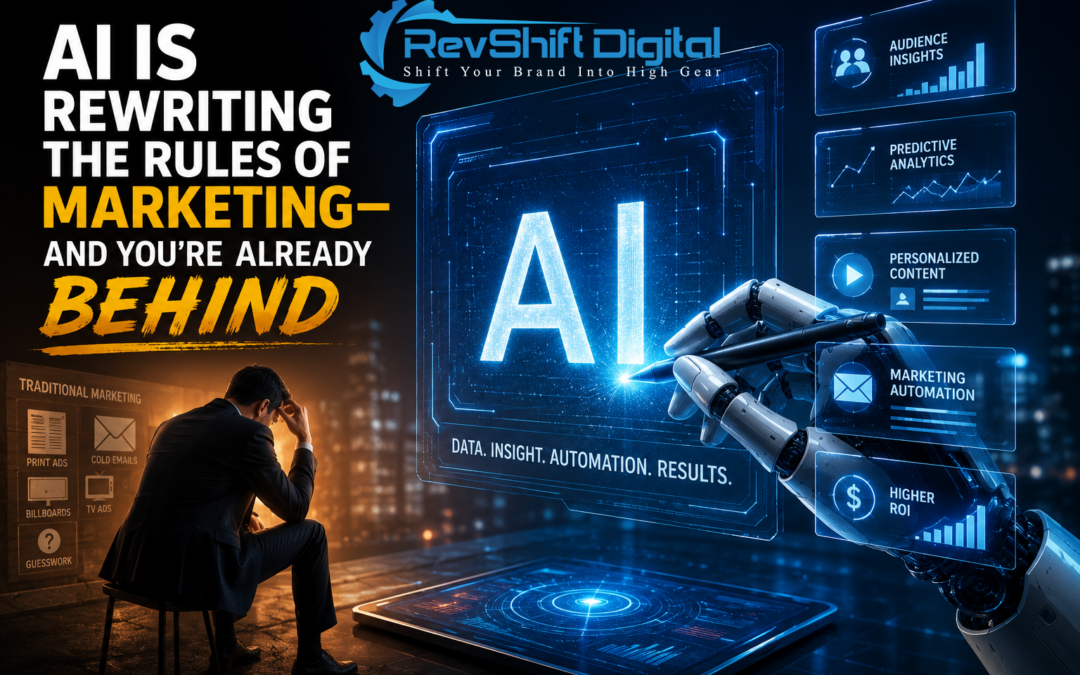
The Marketing Game Has Changed — Again
If you blinked, you might have missed the shift. In the span of just three years, artificial intelligence moved from a curious experiment in marketing departments to the central nervous system of the entire industry. The brands that moved early? They’re pulling ahead at a pace that’s becoming genuinely alarming for everyone else.
In 2026, digital marketing is being transformed by AI-driven personalization, generative content tools, agentic campaign automation, and an entirely new framework for search visibility. This isn’t a trend piece. This is a field guide.
Whether you’re a CMO navigating enterprise strategy or a solo operator managing your own campaigns, understanding where AI marketing is right now — and where it’s heading — is the difference between leading and playing catch-up.
1. Hyper-Personalization Is No Longer Premium — It’s Expected
Gone are the days when “personalization” meant inserting a first name into an email subject line. In 2026, hyper-personalization powered by predictive analytics is rapidly becoming the standard baseline for competitive marketing.
AI systems now analyze customer behavior, purchase history, funnel position, browsing patterns, and even sentiment signals in real time — then deliver a dynamically unique message to each individual. Not segments. Individuals. At scale.
According to WordStream’s 2026 AI marketing research, hyper-personalization and predictive analytics are now letting marketers tailor content and offers in real time, with campaign automation evolving so AI can continuously test and adjust without constant human intervention.
What does this mean in practice? Your email open rates, ad relevance scores, and landing page conversion rates can all see dramatic improvement — not by increasing your budget, but by stopping the practice of sending the same message to everyone.
SEO Tip: Personalized content that deeply addresses user intent also performs better in generative search answers — connecting your personalization strategy directly to your GEO efforts.
2. Claude AI: The Marketing Powerhouse You Might Be Sleeping On
Of all the AI tools reshaping marketing workflows in 2026, Claude by Anthropic may be the most underestimated — and the most powerful for content-heavy teams.
Claude’s standout feature for marketers is its 200,000-token context window. To put that in plain terms: you can paste your entire brand guide, a competitor’s landing page, fifty customer reviews, and a full campaign brief into a single conversation — and Claude synthesizes all of it simultaneously to produce coherent, on-brand output.
By 2026, Claude is used by 70% of Fortune 100 companies. Website traffic to Claude.ai grew more than 10x in under a year — from 16 million to over 164 million monthly visits. That’s not hype. That’s mass adoption by sophisticated organizations.
How Marketers Are Using Claude Right Now
- Content at scale: Campaign briefs, blog posts, email sequences, ad copy, product descriptions — all generated with brand-consistent voice and strategic depth.
- Platform-specific social content: One ‘source of truth’ explodes into a full week of platform-optimized posts — different voice for LinkedIn, different energy for Instagram, different format for X.
- Long-form and technical writing: Claude consistently outperforms other models in long-form LinkedIn posts and technical content — producing writing that sounds like a knowledgeable human.
- Competitive analysis: Paste competitor content, ask Claude to identify positioning gaps and strategic opportunities. What used to take a strategy session now takes minutes.
- Workflow integration: Claude connects natively with Google Docs, Zapier, and Make — content generation can be triggered automatically by CRM updates, form fills, or new campaign briefs.
3. Agentic AI: When Your Campaigns Run Themselves
The most significant macro-shift in AI marketing in 2026 isn’t a tool — it’s a paradigm. We’ve officially entered the age of Agentic AI.
Agentic AI refers to autonomous systems capable of completing complex, multi-step marketing tasks without human intervention at every stage. Managing ad bids, booking appointments, building landing pages from high-performing ad copy, auditing SEO across thousands of pages — these tasks now happen automatically, triggered by data rather than a human to-do list.
According to Gartner’s 2026 marketing predictions, AI agents and GenAI-powered technology are redefining marketing channels, accelerating execution, and elevating the strategic role of data and content governance. The brands building AI-ready operating models now will have a structural advantage that compounds over time.
4. Google Marketing Live 2026: The Agentic Ad Ecosystem Arrives
Google Marketing Live 2026 unveiled what may be the most significant shift in paid advertising in a decade. Google is going all-in on AI-native advertising, and the silos between Search, YouTube, and conversational AI have officially collapsed.
Ask Advisor: Your Unified AI Campaign Manager
Google introduced Ask Advisor — a single, unified AI agent built with Gemini that connects Google Ads, Google Analytics, Merchant Center, and Google Marketing Platform in one conversational interface. Advertisers can now diagnose campaign issues, surface performance insights, and optimize across all platforms through a single chat experience.
Asset Studio: AI-Powered Creative Generation at Scale
Google’s Asset Studio received a major upgrade, now powered by multimodal Gemini. Advertisers can use natural language prompts to generate policy-ready ad creative — images, video, and copy — and run one-click A/B tests directly in the platform. What previously required a creative team and days of production can now be iterated in hours.
AI Max for Shopping Campaigns
For retail and e-commerce marketers, AI Max for Shopping adapts automatically to modern search behavior, helping brands reach shoppers at the moment of discovery — including in AI-powered conversational search experiences.
5. GEO: Generative Engine Optimization and the New Search Reality
If SEO was the defining marketing discipline of the 2010s, GEO — Generative Engine Optimization — is defining the 2020s. Brands are now optimizing not just for traditional search result pages, but for appearing inside AI-generated answers.
When a user asks an AI assistant “What’s the best project management tool for remote teams?” — brands either show up in that answer or they don’t. There is no page two. Voice commerce compounds this urgency — projected to reach $147.9 billion by 2030.
GEO Optimization Checklist
- Answer specific questions your customers would ask an AI assistant
- Use structured, factual, authoritative language — AI systems favor credible sources
- Build domain authority through consistent, expert-level content publishing
- Optimize for conversational queries, not just keyword phrases
- Include structured data markup to make your content machine-readable
6. AI-Powered Video Marketing: Scale Without Sacrifice
Video dominates marketing strategy in 2026, and AI has made what used to require a full production team achievable by a single marketer. AI tools now enable brands to produce cinematic-quality video content in hours instead of weeks. The standard workflow: create one pillar piece of content, then use AI tools to adapt it across platforms — different aspect ratios, hook styles, and caption lengths — while maintaining message consistency.
7. The Human Element: What AI Can’t Replace
Here’s what the most sophisticated AI marketing practitioners understand in 2026: AI is infrastructure, not strategy. AI generates content at scale. Humans decide what the brand stands for. AI optimizes bids automatically. Humans decide which markets to compete in.
The most successful marketers aren’t handing everything to AI — they’re using AI for execution and bringing their human creativity, customer empathy, and strategic judgment to the decisions that matter most. Ethical AI use matters too — brands that balance personalization with privacy transparency will build deeper customer relationships.
Your AI Marketing Action Plan for 2026
This Week
Start with Claude. Go to claude.ai, paste your brand guide and your last three pieces of content, and ask for a strategic audit. The quality and depth of the analysis — in minutes — will recalibrate your expectations for what’s possible.
This Month
Audit your Google Ads account specifically for AI Max and Asset Studio capabilities. If you’re not using these tools, you’re spending more for worse results than competitors who are.
This Quarter
Publish one GEO-optimized piece of content per week — articles, guides, or posts that directly answer questions your target customer would ask an AI assistant.
Ongoing
Develop a hybrid content workflow: one pillar piece per week, then use Claude to distribute it across every platform in platform-native formats. One input. Maximum reach.
Frequently Asked Questions
What is the most important AI marketing trend in 2026?
Agentic AI — autonomous systems that execute marketing tasks without constant human intervention — represents the most significant structural shift. Combined with hyper-personalization, it’s fundamentally changing what marketing teams can accomplish at scale.
Is Claude better than ChatGPT for marketing?
For long-form content, technical writing, and tasks requiring large amounts of context (brand guides, competitor research, full campaign briefs), Claude’s 200K context window gives it a practical advantage. Most marketing professionals in 2026 use multiple tools strategically.
What is Generative Engine Optimization (GEO)?
GEO is the practice of optimizing your content to appear within AI-generated answers — like those from ChatGPT, Google AI Overviews, or voice assistants — rather than just traditional search result pages.
What did Google announce at Marketing Live 2026?
Key announcements included Ask Advisor (a unified AI agent across all Google ad platforms), Gemini-powered Asset Studio for AI creative generation, AI Max for Shopping campaigns, and a rebuilt Google Analytics 360 with cross-channel measurement including TikTok, Pinterest, and Snap data.
If you want to turn these trends into a clear, scalable strategy for your business, we can help.
👉 Let’s map out your growth strategy:
Schedule a Strategy Session