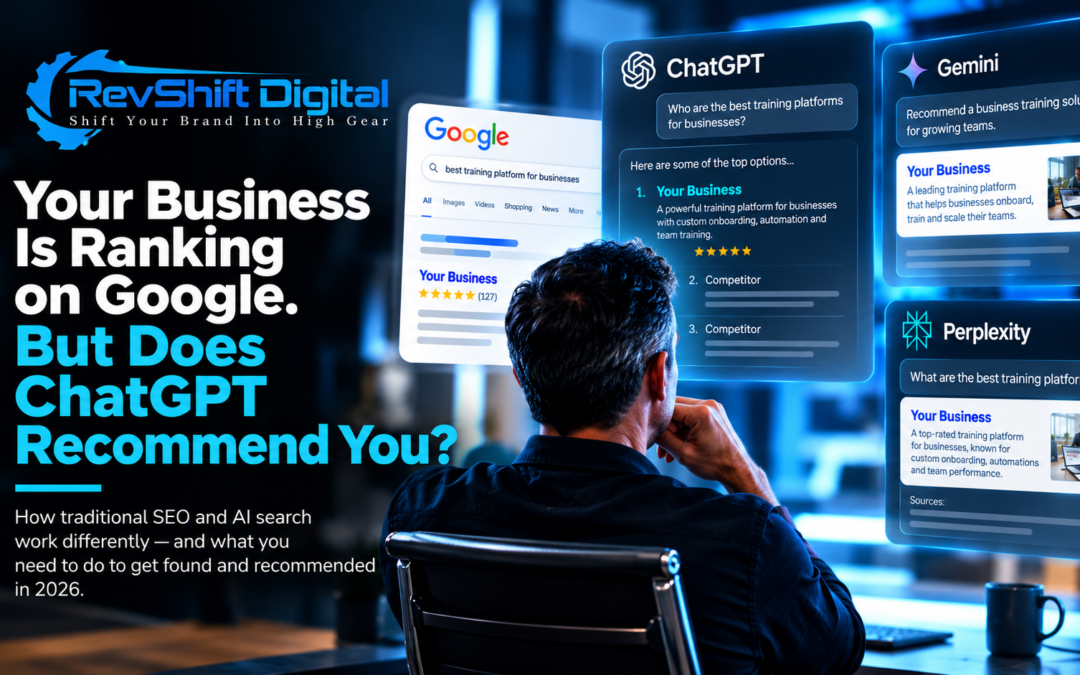
Your Business Is Ranking on Google. But Does ChatGPT Recommend You?
You worked hard to get your business onto page one of Google.
Your website is optimized. Your Google Business Profile is dialed in. You have reviews, backlinks, content, and maybe you’ve spent years building your organic visibility.
Then a potential customer opens ChatGPT and asks:
“Who are the best companies for [your service] in my area?”
Are you in the answer?
That’s becoming an increasingly important question.
Search isn’t disappearing. It’s evolving.
Consumers can now ask ChatGPT, Gemini, Perplexity, and Google’s AI-powered search experiences questions that used to require several separate Google searches.
Instead of searching:
“best [service] near me”
then opening five websites, reading reviews, comparing companies, and returning to Google, a consumer can increasingly ask:
“I need a [service] company near me that specializes in X, has strong reviews, works with businesses like mine, and isn’t the cheapest option but has a reputation for quality. Who should I consider?”
That’s a fundamentally different search.
The customer isn’t simply asking an algorithm to find websites.
They’re asking AI to help make a decision.
And that creates a new challenge for businesses:
It’s no longer enough for search engines to find you. AI systems need to understand who you are, what you do, why you’re credible, and when you’re relevant enough to include in an answer.
Welcome to the next evolution of search.
SEO Isn’t Dead. But Search Has Changed.
Let’s clear something up first.
Traditional SEO still matters.
A lot.
Google explicitly says that SEO best practices remain relevant to its generative AI search experiences. Google’s AI features use its existing Search ranking and quality systems to retrieve relevant web pages and help generate answers.
ChatGPT Search can also search the web for current information and provide links to the sources it uses. Perplexity similarly builds answers by searching and synthesizing information from multiple sources.
So this isn’t:
SEO → dead → replace it with GEO.
It’s closer to:
Traditional Search Visibility + AI Visibility = Modern Search Strategy
The difference is what happens after your information is discovered.
Ranking vs. Being Recommended
Traditional search has historically worked something like this:
Query → Search Results → Website Click → Research → Decision
AI-assisted search can compress that journey:
Question → AI Research/Synthesis → Recommendation → Website/Action
That distinction matters.
With traditional SEO, your primary objective was often to rank your webpage high enough to earn the click.
With AI search, another question enters the equation:
Does the system understand your business well enough to confidently include it in its response?
Imagine two competing companies.
Company A
Has a reasonably optimized website.
It ranks well for several important keywords.
But its website mostly consists of generic service pages:
-
HVAC Repair
-
HVAC Installation
-
Commercial HVAC
-
About Us
-
Contact Us
There’s very little information elsewhere establishing exactly who the company serves, what it specializes in, what makes it different, or why someone should trust it.
Company B
Has similar traditional SEO fundamentals.
But across its website and the broader web, there’s considerably more context.
It clearly explains:
-
Who it serves
-
Where it operates
-
What problems it solves
-
Its areas of specialization
-
The people behind the company
-
Its experience
-
Customer outcomes
-
Frequently asked questions
-
Pricing considerations
-
Comparisons and alternatives
-
Reviews and third-party mentions
-
Original expertise and educational content
Which business gives an AI system more information to work with?
That’s where the opportunity begins.
Four AI Search Environments Businesses Should Understand
Although people tend to lump everything together as “AI search,” these systems aren’t identical.
1. ChatGPT
ChatGPT can search the web when current information would improve an answer and provide citations and links to sources.
That means businesses have another potential discovery path:
Customer question → ChatGPT searches/reasons → your business or content becomes a source → customer discovers you
But being indexed somewhere on the internet doesn’t guarantee you’ll appear.
Your business needs enough relevant, understandable, trustworthy information for the system to connect your company with the user’s question.
2. Google AI Overviews and AI Mode
Google represents an interesting convergence between traditional SEO and generative AI.
AI Overviews provide AI-generated summaries with links to relevant websites, while Google’s AI Mode allows people to continue into conversational follow-up questions.
Google says these AI search features are built upon its existing Search ranking and quality systems.
That’s important.
The SEO work you’ve already done isn’t suddenly worthless.
But Google can now synthesize information rather than simply displaying ten blue links.
3. Gemini
Gemini can use Google Search grounding to access current publicly available web information and provide sources supporting its answers.
For local businesses, Google’s ecosystem becomes especially interesting because Gemini technology can also be grounded using Google Maps data, including information about real-world businesses.
That makes maintaining accurate, consistent information across your website, Google Business Profile, Maps presence, reviews, and other authoritative sources increasingly important.
4. Perplexity
Perplexity was built around answer-based search.
Rather than primarily returning a list of webpages, it searches multiple sources and synthesizes them into an answer with citations.
From a marketing perspective, that introduces an interesting objective:
You don’t necessarily have to be the destination for every search.
Sometimes you want to become one of the sources shaping the answer.
What Makes a Business “AI Friendly”?
There isn’t a magic ChatGPT optimization tag.
And anyone promising to “guarantee #1 rankings in ChatGPT” should raise the same skepticism that old-school guaranteed Google rankings did.
Instead, think about AI visibility as a collection of signals.
1. Make Your Business Easy to Understand
An AI system shouldn’t have to figure out what your company actually does.
Your website should make entities and relationships extremely clear:
Company → Service → Customer → Problem → Solution → Location → Expertise → Evidence
Don’t hide your value proposition behind clever marketing language.
Say what you do.
Say who you do it for.
Say where you do it.
Explain why you’re qualified to do it.
2. Build Topical Authority, Not Just Keyword Pages
A website with 50 thin articles targeting 50 keyword variations isn’t necessarily demonstrating expertise.
Build interconnected content around the questions customers actually ask.
If you sell commercial roofing, don’t stop at:
Commercial Roofing Las Vegas
Build the knowledge surrounding the buying decision:
-
How much does commercial roofing cost?
-
Repair versus replacement
-
TPO versus PVC roofing
-
How long does a commercial roof last?
-
What warranties matter?
-
How does Las Vegas heat affect roofing?
-
How should contractors be evaluated?
-
What causes premature roof failure?
You’re giving both people and machines context about your expertise.
3. Strengthen Your Entity Across the Web
Your website isn’t the only place an AI system can encounter your company.
Depending on the system and query, relevant information can come from search indexes, directories, reviews, publications, social profiles, business databases, Maps data, news coverage, industry websites, and other third-party sources.
Consistency matters.
Your business shouldn’t appear to be five slightly different companies depending on which source is being examined.
4. Publish Information Worth Citing
This may become one of the biggest content opportunities of the AI-search era.
Don’t just publish another rewritten version of information already available on 1,000 websites.
Publish something worth referencing.
That could include:
-
Original research
-
Industry statistics
-
Case studies
-
Experiments
-
Benchmarks
-
Detailed tutorials
-
Proprietary frameworks
-
Expert commentary
-
Surveys
-
Pricing data
-
Before-and-after results
The question changes from:
“What keywords can we rank for?”
to:
“What information can we become a trusted source for?”
That’s a much stronger content strategy regardless of what happens with AI search.
Don’t Abandon Google SEO for “GEO”
This is where businesses can waste a lot of money over the next few years.
Every major change in digital marketing creates a new crop of consultants selling the death of whatever came before it.
Don’t rip apart a successful SEO strategy because someone tells you SEO is dead and everything is now “Generative Engine Optimization.”
The better strategy is convergence.
Keep doing the fundamentals that make your business discoverable:
Technical SEO + Content + Authority + Local SEO + Reviews + Structured Data + Brand Signals
Then improve how clearly all of those assets communicate your business, expertise, products, services, people, and authority to AI systems.
Good AI-search optimization should make your traditional search presence stronger, not weaker.
Here’s the Test We Recommend
Open several AI platforms and start asking the questions your customers would actually ask.
Don’t only search your company name.
That’s too easy.
Ask:
“What are the best [your service] companies in [your city]?”
Then get more specific.
“Which companies specialize in [specific problem]?”
“Compare the top companies for [service].”
“Who would you recommend for a business with [specific situation]?”
“What should I look for when hiring a [service provider]?”
Then look at the results.
Does your company appear?
Are your competitors appearing?
Are you accurately described?
What sources are being cited?
What characteristics seem to be associated with the businesses that appear?
And perhaps most importantly:
What does the AI know about your competitors that it doesn’t know about you?
That’s your gap.
The New Goal: Be Findable, Understandable and Recommendable
Google rankings still matter.
Traffic still matters.
Links still matter.
Technical SEO still matters.
But search is moving beyond a list of links.
Consumers increasingly have access to systems capable of researching, comparing, summarizing and helping them make decisions.
That means your digital presence has another audience besides your potential customer.
The machines helping your potential customer make the decision.
Your business needs to be:
Findable.
Search engines and AI systems need access to your information.
Understandable.
They need enough context to know exactly who you are, what you do and when you’re relevant.
Credible.
Claims need evidence, authority and corroboration.
Recommendable.
When someone describes a problem you solve, your business should have enough digital authority and context to deserve consideration.
That’s the evolution we’re paying attention to at RevShift Digital.
Because the question isn’t just:
“Does your business rank on Google?”
It’s increasingly:
“When your next customer asks AI who they should call, will it know enough about your business to include you?”
If you want to turn these trends into a clear, scalable strategy for your business, we can help.
👉 Let’s map out your growth strategy:
Schedule a Strategy Session